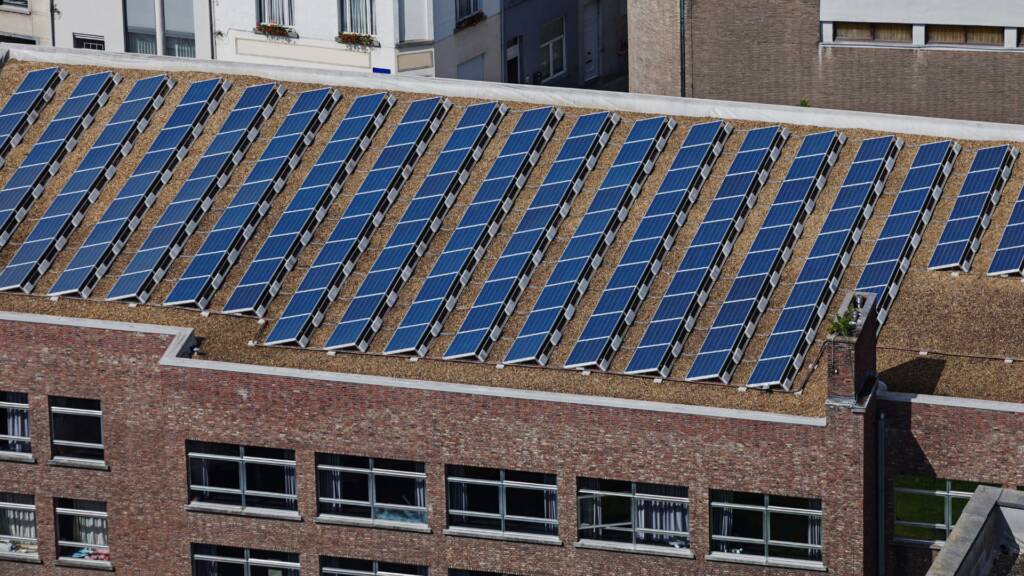
Solar panels for apartment buildings and residential communities can significantly reduce shared utility costs and enhance energy resilience. By installing a solar power system, essential services such as elevators, common-area lighting, access control systems, intercoms, and video surveillance can continue to operate during grid outages or periods of high demand.
For multi-apartment and high-rise buildings, we design rooftop solar systems equipped with Battery Energy Storage Systems (BESS) and prioritize loads to ensure that critical infrastructure remains powered when it is most needed.
The benefits include lower electricity bills, increased energy independence, and reliable operation of shared building systems – all in accordance with European energy efficiency standards and local regulations.
Page Contents
Who Is This Solution For?
Residential Associations/Apartment Complexes
To ensure the continuous operation of essential services such as elevators, intercoms, access barriers, common area lighting, and video surveillance.
New Residential Developments
An ideal solution during building commissioning or for selling apartments with ready-to-use energy infrastructure.
High-Rise Buildings with Flat Roofs, Terraces, and Parking Areas
Efficiently utilize roofs, canopies, and facades for solar installations that are both functional and visually appealing.
Buildings with Elevators, Security Systems, and Server Rooms
Specifically designed to keep critical systems operational during power outages or grid instability.
Our Services for Residential Associations and Multi-Storey Buildings
Audit and System Design
We conduct on-site inspections of the roof, perform measurements, assess loads, determine capacity sizing, and provide a preliminary cost estimate.
Equipment Selection and Supply
We offer complete system assembly, which includes solar panels, inverters, mounting structures, and protective components.
Turnkey Installation
Our installations are clean and precise, featuring proper labeling, organized cabling, and system commissioning. For flat roofs, we utilize low-profile mounting systems ensuring a clean geometry.
Load Prioritization and Energy Island Mode
We prioritize critical loads first – such as elevators and security systems – followed by lighting and pumps. Our microgrid operation is configured to handle power outages.
Battery Energy Storage System (BESS) and Tariff Optimization
We calculate battery capacity based on peak loads, manage night charging and daytime discharge, and establish power limits and usage schedules.
EV Carports
We design solar carports and integrate paid EV charging options (per hour or per kWh), along with a billing system integration.
Anti-Vandal and Fire Safety Package
Our safety features include concealed cabling, tamper-proof fasteners, UV marking, and controlled access systems.
Modernization and Scalability
We ensure future expansion possibilities without needing a redesign. This includes adding more panels, a BESS, inverters, new loads, or EV charging points.
Technical Inspections and Audits
We conduct regular inspections and performance audits of the installed solar power systems.
How a Solar Power System Works in High-Rise Buildings
- Solar panels are installed on the roof of the building or in adjacent areas if the roof is not suitable. Inside the building, inverters are placed to convert the direct current (DC) power generated by the panels into alternating current (AC) power, which is used by the building’s electrical system.
- Initially, solar energy is utilized to supply power to common areas. If the energy generation exceeds consumption, the surplus can either be:
- Exported to the grid through net billing, which generates additional income for the residential association, or
- Stored in batteries (Battery Energy Storage System – BESS) for later use.
What a 10 kW System Powers in a 9-Storey Building
A solar power system with a capacity of 10 kW can support the following:
- Entrance, outdoor, and parking lighting (LED) in normal operation
- Intercoms, access barriers/access control systems, and other low-consumption automation devices
- Video surveillance and networking equipment (routers, switches)
- Cold water and domestic hot water circulation pumps on a scheduled, sequential basis
- One passenger elevator operating in standby/cyclic mode (short trips with pauses between runs)
- Building security and automation systems (controllers, sensors, and server room – basic load)
A 10 kW solar system can support the specified loads during daylight hours. However, for nighttime use or during power outages, a Battery Energy Storage System (BESS) is necessary.
For instance, a 10 kWh BESS can provide up to 6 hours of backup power, depending on which systems are in use. If only the lighting and security systems are operational, the runtime will be longer; if an elevator is included, the runtime will be shorter.
Do you have questions? Our engineers are here to help you understand everything and find the right solution.
Benefits of a Solar Power System for Residential Associations
Cost Savings
By generating solar power during the day and charging a battery energy storage system (BESS) at night, electricity costs for common areas can be significantly reduced.
Security During Outages
Essential services such as elevators, intercoms, and video surveillance will remain operational even during power outages, enhancing safety and security.
Rooftop Monetization
Net billing and solar EV carports with paid charging options can create additional revenue streams for the residential association.
Up to 12 Hours of Autonomy
Critical systems will continue to operate and remain under control during outages, providing peace of mind to residents.
Solution Packages for Residential Associations and Multi-Storey Buildings
Savings
Choose this solution when:
You have flat, unobstructed roofs up to 16 stories high and your main goal is to reduce daytime electricity costs.
Configuration (PV, grid-tied inverters, net billing):
- For buildings with 1 entrance: 10-15 kW
- For buildings with 2-3 entrances: 25-40 kW
- For buildings with 4-6 entrances (entire building): 60-90 kW
Benefits: Achieve up to a 50% reduction in daytime electricity costs for common areas.
Backup Power Solutions
When to сhoose this system:
Ideal for standard buildings up to 16 storeys where cost savings and backup power are needed.
Configuration Options (Hybrid System + Battery Energy Storage System – BESS, ATS):
- 1 Entrance: 10-15 kW + BESS 10-20 kWh
- 2-3 Entrances: 25-40 kW + BESS 20-60 kWh
- Entire Building: 60-100 kW + BESS 60-200 kWh
Key Benefits:
- Load prioritization (elevators → access control/video → lighting)
- Up to 10 hours of autonomy
- Peak shaving
- Night-time battery charging
Reliability
When to choose this system:
This configuration is ideal for high-rise buildings with two or more elevators, particularly in areas prone to power outages.
Configuration (Dual Power Loops, ATS):
- For buildings with 2-3 entrances:
- Power requirement: 80-150 kW
- Battery Energy Storage System (BESS): 150-400 kWh
For an entire building or residential complex:
- Power requirement: 150-220 kW
- BESS: 300-600 kWh
What You Get:
This setup ensures uninterrupted operation of critical systems and provides up to 12 hours of autonomy.
Monetization
When to choose:
Buildings with underground parking or strong demand for EV charging.
Configuration:
- Solar carports 20-80 kW
- 2-12 EV chargers (7-22 kW)
- BESS 30-150 kWh as a buffer for night charging and peak demand
What you get:
Clear monetization through paid or smart EV charging, partial supply of common areas, and dynamic load management.
How We Work
- Initial consultation and energy usage review
- On-site inspection and system assessment
- Technical design and cost modelling
- Installation scheduled around academic calendars
- Monitoring, maintenance, and support
Why Choose Rubiсon
- 50+ energy projects delivered
- Proven experience with 10-500 kW+ systems
- Engineering-first approach (load profile + electrical reality, not “generic kits”)
- Financing strategy support
- Technical audit and tailored system architecture
- Quote in 24 hours, quick installation
- Turnkey EPC: design → installation → support
- Transparent pricing: fixed budget, no hidden costs
FAQ
Yes, it does. While energy generation may be lower during these periods, critical systems will remain powered thanks to the Battery Energy Storage System (BESS) and load prioritization. Net billing helps offset costs during times of higher generation.
This depends on several factors, including the number of floors, elevators, pumps, available roof area, and your specific goals, such as cost savings or backup power. We can provide a precise recommendation after a 15-minute briefing and audit.
No, backup power is supplied only to common areas, which include elevators (operating in duty/cyclic mode), intercoms, video surveillance, lighting, pumps, and building automation systems.
Yes, it will operate in duty/cyclic mode, which accounts for the starting currents. We recommend using a Variable Frequency Drive (VFD) or a soft starter.
The duration depends on BESS capacity and the active loads. A typical scenario for a 16-storey building with one elevator offers 4-6 hours of power for critical systems when using a BESS of 150-200 kWh. For longer autonomy, a larger battery capacity or stricter load priorities may be necessary.
Yes, EV chargers can be installed and will operate when there is surplus generation during the day. However, during blackouts, EV chargers will be disabled to conserve BESS capacity.
We need the building address, the number of floors and entrances, the number/type of elevators and pumps (for Domestic Hot Water (DHW) or Chilled Water (CHW, as well as access to the roof and electrical rooms, and recent electricity bills. We will handle the rest.
Pricing varies based on PV/inverter capacity, BESS size, roof conditions, and project goals. We can provide 2-3 budget scenarios within 24 hours after the briefing.
Yes, we design modular systems that allow you to add panels, inverters, BESS, and new load priorities without needing to rework the entire system.
- Solar panels: 25-30 years
- Inverters: 10-15 years
- LFP BESS: 6,000+ cycles (depending on the operating profile)
Official manufacturer warranties apply, in addition to our ongoing service and maintenance.